Is Aluminum a Magnetic Metal?
The Difference Between Aluminum and Magnetic Metals
True magnetic metals (specifically, ferromagnetic materials) include iron, cobalt, and nickel; these metals possess unpaired electrons in their outermost electron shells. According to the Pauli exclusion principle in quantum mechanics, two electrons sharing the same orbital must have opposite spins, causing their magnetic effects to cancel each other out. Thus, metals like copper, silver, and gold—which have paired electrons in their outermost shells—do not exhibit magnetism.
In magnetic metals, the outermost electron shell contains an unpaired electron. This electron interacts strongly with neighboring atoms via quantum forces that compel the unpaired electrons of those neighbors to align their spins, thereby forming magnetic domains. The tiny magnetic fields of countless atoms align in unison. When exposed to an external magnetic field, these domains rapidly orient themselves in the same direction, generating an immensely powerful macroscopic magnetic force.
While the presence of magnetic domains is a prerequisite for generating magnetic force, the metal’s crystal structure also influences the macroscopic manifestation of that force. Although aluminum does possess unpaired electrons, its face-centered cubic (FCC) crystal structure is highly symmetrical, which inhibits the long-range ordered alignment of the unpaired electrons’ magnetic moments. Furthermore, thermal motion easily disrupts this alignment: at room temperature, thermal energy causes the magnetic moments of aluminum atoms to move violently and randomly. Without a strong force to “bind” them together, these unpaired electrons behave like an undisciplined crowd, each pointing in a different direction, causing their magnetic effects to cancel each other out. Only when an extremely strong external magnetic field is applied do they reluctantly shift slightly to align with that field (producing very weak paramagnetism). In contrast, iron’s unique body-centered cubic (BCC) crystal structure facilitates a strong “quantum exchange interaction” between atoms, enabling the formation of magnetic domains.
The fundamental difference between aluminum and strongly magnetic metals lies not in the mere presence or absence of unpaired electrons, but in the number of such electrons and whether the crystal structure allows their magnetic fields to align spontaneously and uniformly to form magnetic domains.
Can Aluminum Be Made Magnetic?
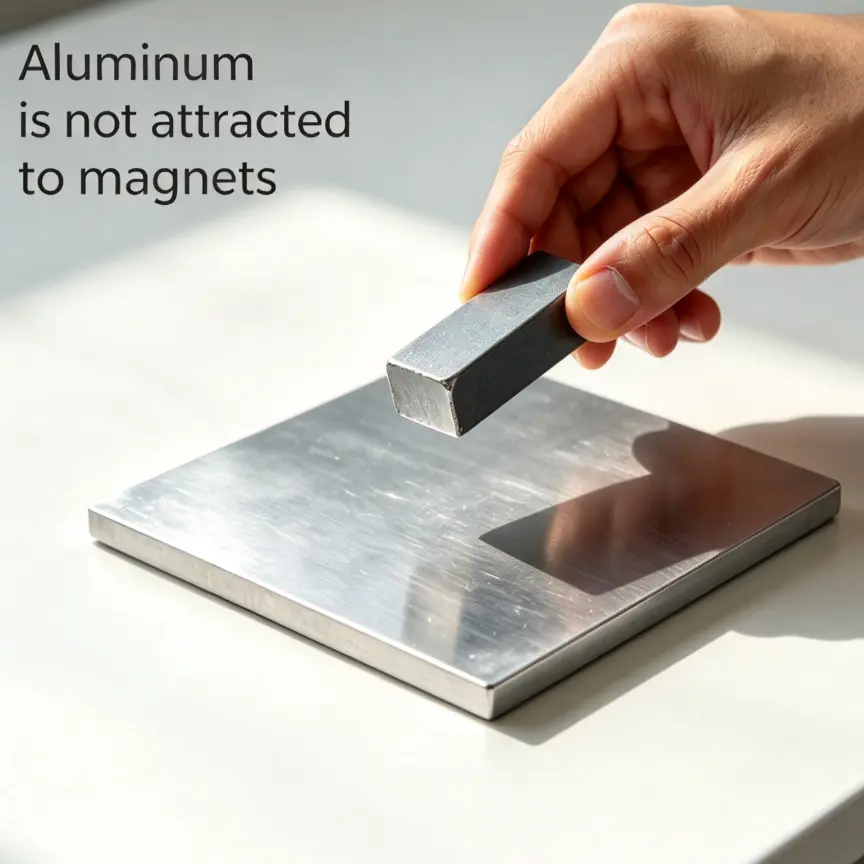
Aluminum cannot become a permanent magnet. Neither rubbing it with a magnet nor applying a standard magnetic field can alter its atomic structure. However, a unique interaction does exist between aluminum and magnets. If a strong magnet sweeps rapidly across the surface of aluminum, it induces an electric current within the metal known as an “eddy current.” This current generates an opposing magnetic field, creating a repulsive force against the magnet. Engineers have harnessed this interesting physical phenomenon to design smooth braking systems for roller coasters and high-speed trains.
Industrial Applications of Non-Magnetic Aluminum
Aluminum’s “non-magnetic” (specifically, non-ferromagnetic) nature makes it indispensable in fields where magnetic interference must be avoided, magnetic field distortion prevented, or extreme precision required. Key applications leveraging aluminum’s non-magnetic properties include:
- Medical and Precision Scientific Instruments: MRI scanners rely on extremely powerful magnetic fields. Any magnetic material within the scanning room could distort the magnetic field or become a dangerous projectile. Aluminum’s weak paramagnetism ensures absolute safety and reliability when used in MRI patient beds, tables, and structural supports. It is also used in precision laboratory measurements (like NMR or particle physics) to avoid interfering with precision measurements.
- Aerospace and Navigation Systems: Aircraft and satellites rely heavily on precise navigation systems and magnetic sensors. Using non-magnetic aluminum components eliminates the risk of magnetic interference that could compromise flight safety or reduce navigation accuracy. Manufacturers also construct aircraft fuselages from aluminum to achieve lightweighting without introducing additional magnetic interference.
- Electronics, Electrical Systems, and Communication Equipment: Sensitive electronic devices require shielding against external magnetic interference. Aluminum housings and panels effectively prevent unwanted magnetic fields from interfering with internal circuitry while leveraging the metal’s high electrical conductivity. Additionally, aluminum coils are widely used in equipment such as electric vehicles and power transformers to maintain stable electromagnetic performance.
- Transportation and Specialized Exploration: Aluminum alloys are used to manufacture non-magnetic components for high-speed trains to prevent eddy current losses during operation. In underwater and marine exploration, non-magnetic aluminum tools do not trigger magnetic anomaly detectors, offering a distinct advantage.
- Flammable, Explosive, and Specialized Safety Scenarios: Aluminum is not only non-magnetic but also does not produce sparks upon impact. This characteristic makes it an ideal material for manufacturing explosion-proof equipment used with flammable or explosive substances, as well as for electrical equipment shielding and instrument components.
In summary, aluminum’s non-magnetic nature, combined with its lightweight, corrosion-resistant, and easily machinable properties, makes it an indispensable material in modern high-tech industries, medicine, aerospace, and precision instrument manufacturing.
Applications for Magnetic Metals
While aluminum does not interact magnetically with magnets, ferromagnetic metals such as iron and cobalt are essential materials for manufacturing magnets. Industry utilizes these metals to produce powerful motors, heavy-duty generators, and transformers. They also serve as core materials for everyday items such as loudspeakers, hard disk drives, and refrigerator magnets. Their ability to contain and guide magnetic fields precisely enables the operation of modern electronic devices and power grids.
Lex Hardware: Professional Custom Metal Services
Selecting the right metal for a project requires an understanding of these unique physical properties. Lex Hardware specializes in precision metal processing and custom manufacturing services. Whether you require non-magnetic aluminum enclosures for sensitive electronics or durable steel components for structural supportmanufactured via CNC machining or die casting, our team offers expert guidance and top-tier manufacturing.
Contact Lex Hardware today for expert advice and high-quality custom metal solutions.
Reference resources